

Eat & Drink
Gin o'clock!
Getting the simple things right makes for a great classic gin. But why, in 2026, has this unlikely – and once unloved – spirit made such a colossal comeback? Lighthouse Gin's head distiller Rachel Hall has the answers.
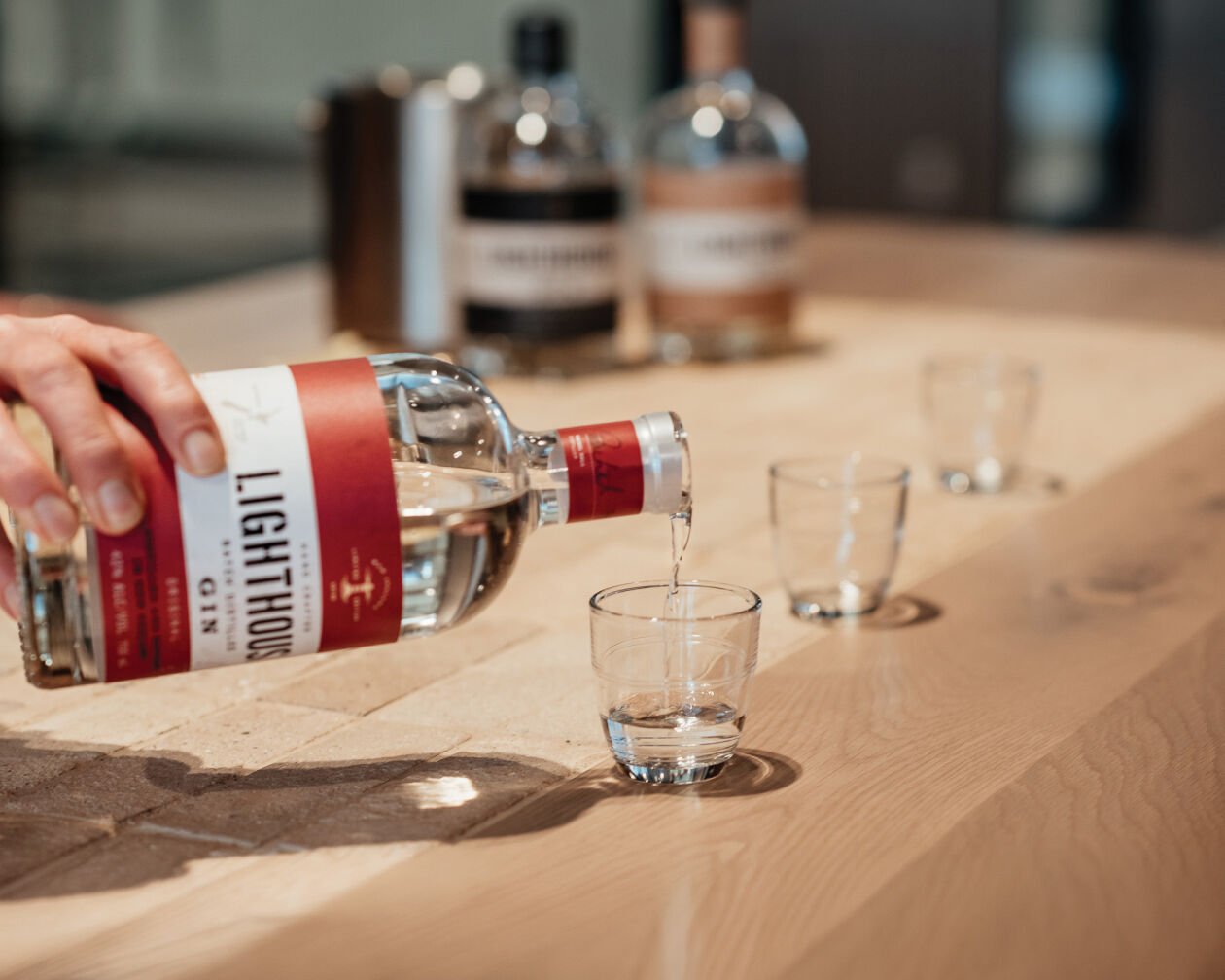
Once dismissed as old-fashioned, within the last decade gin has become a go-to spirit. Something once deemed as perilous to polite society – 'Mother's Ruin', indeed – is these days a conversation starter, a popular Friday afternoon tipple, even a small batch collector's item. Walk into a bottle store today and you'll find row upon row of local labels; head to a market and there's often a tasting table promising citrus, florals or native botanicals.
Lighthouse Gin, distilled in the Wairarapa and sporting the famous red and white stripes of the Cape Palliser lighthouse on its familiar label, has been part of the story of gin's renaissance.
And helping guide what's inside the bottle from boutique curiosity to export success has been head distiller, Rachel Hall.
Rachel didn't arrive on the scene with a chemistry degree or a grand plan to run a still. She admits she didn't even touch the stuff when she began working for company co-founder Andrew Wright (and his wife Sue) at a local driving range as a "weekends and school holidays girl."
While Rachel headed off on her OE, came back home, married, had kids and forged a career in telecommunications, Andrew and friend Neil Catherall were beating their own path. Andrew had also established a (non-alcoholic) juice business, Mela Juice. As Rachel tells it, the distillery began in classic Kiwi fashion: "A couple of blokes who played golf together - watching local small batch spirits taking off and wondering, 'why not have a go ourselves?'
"They tried their hand at fruit brandies first, but realised the patience required wasn't going to match the market," she recalls. "Neil had always had a soft spot for gin and figured he could have a go at making that instead."
Reconnecting with Rachel upon her return to the Wairarapa, Andrew asked her to join Mela Juice. While working in a small team proved a refreshing break from the corporate world, it was watching gin being distilled by Neil up close that really sparked her interest.
"I was intrigued… I just started asking lots of questions," she says.
Lighthouse's signature style was starting to take shape: classic, dry, and built around letting the botanicals speak.
The breakthrough wasn't through a flashy marketing campaign; rather, miles and miles spent on the road, plenty of conversations, and a steady stream of small tastings. It was slow going and the New Zealand gin scene was still in its infancy – Lighthouse was usually the only gin maker at any given food show back then.
"But we learnt that getting people to try it was the best way to get people to like it and buy it," says Rachel. "The face-to-face approach also rebuilt trust in gin as something wonderful, not like what many might have associated it with in years gone by."
In 2014, with Neil ready to retire and the business changing hands, Rachel assumed her time in the distillery was up. Instead, the then-CEO asked if she'd like to be the next distiller.
"I'm like, 'Yeah, absolutely!'" she laughs. And with that, she found herself responsible for one of the country's best-known gins.
So, why the resurgence in interest in gin? Rachel doesn't sugar-coat the past: "Gin used to be nasty. It was horrible… it didn't have any love put into it. But yes, the craft boom has changed that. You have better base spirits, careful distilling, and a return to real botanicals rather than shortcuts.
"Modern distillers have widened the playing field, offering everything from spicy and juniper-forward to light and floral, citrus-led, or even colour-changing. For many drinkers, the surprise is simple: it tastes good and it suits the way we like to drink at home, with tonic, ice, and time to savour it."
While there are now all sorts of trends evident in the world of gin distilling, Rachel says Lighthouse has largely resisted the temptation to chase every new flavour wave.
"There are plenty of different distilleries out there offering all sorts of takes on it, and that's great. It means we can just concentrate on what we do, because we really value consistency. We've always been a classic distiller.
"Part of that is practical – small distilleries like us don't have the luxury of tying up money in a trend that might fade before it sells. But it's also about reliability. When someone buys our gin, they know it; they want it to taste the way they remember," she says.
While Lighthouse's familiar bottle is now widely available around the country, success for the company hasn't meant leaving home. Everything is still made and exported from their base in Martinborough, and their biggest overseas market is now the United States.
A standout export milestone came when Lighthouse was selected by the UK's Craft Gin Club to join their line-up. "The only New Zealand gin ever invited," says Rachel.
It also triggered their biggest order at that time: more than 17,000 bottles. The kicker? "This was before we had our beautiful big Carl still that we use today – we had to make all of that consignment in our little old pot still, and it was all bottled and labeled by hand."
Ask her what makes a great gin and Rachel doesn't start with a secret botanical or a trendy garnish – it's all about the fundamentals.
"Gin is made of three main ingredients," she explains. "You have your neutral spirit, your botanicals, and your water. Water in particular is where Lighthouse has an edge. We use natural spring water from Wharekauhau, which is beautiful and clear and naturally soft. There are no contaminants, and so we don't have to do anything to it."
When Rachel cuts the over-proof spirit down to bottling strength with Wharekauhau spring water, it gives the gin "a bit more character," she says. "I call it 'soul'."
It's not romance for romance's sake – hard water can literally throw a fault through the spirit, creating cloudiness or flakes. For Rachel, needing to distill water to make it suitable means the end product is flat and missing something crucial.
For all the talk of innovation, her own favourite way of enjoying gin remains pleasingly straightforward.
"I just love a good G&T," she says. "It's refreshing. It's rewarding. It can be a little end-of-the-day ritual."
Simple. And in a scene crowded with ambitious distillers, Lighthouse's confidence in the classics feels less like nostalgia and more like a blueprint for staying power.