

Living
Collaboration and Clay
Enlivening the impressive environment within the recently opened Pacific Lakes centrepiece, the Pavilion, a cohort of talented artisans were invited to design and sculpt bespoke art pieces.
Within The Pavilion at Pacific Lakes in Papamoa, timber, light, and texture all work together to create a unique environment that feels considered rather than constructed.
Commissioned as part of the impressive new community building's fit-out, overseen by interior design agency Space Studio, ceramicists Peter Collis, Julie Collis, Stephen Lee and Iza Lozano have created a collection of bespoke vessels to sit within the space – not as centrepieces, but as anchors and talking points. The beautiful ceramics are joined by intricate, timeless woven sculptures by Arrowtown artist Jasmine Clarke, along with oversized lampshades above.
It's a collaboration that blends decades of experience. And while the brief was all about consistency of scale, the interpretations are distinctly individual.
For Peter and Julie Collis, this is familiar territory. Between them, the husband-and-wife team bring more than half a century's worth of experience to the potter's wheel.
"I made my first pots when I was 14 – that's 60 years ago now," says Peter. "Julie and I have worked together for a long time. She designs; I make; then we finish them together."
Peter says the focus of his work is the exploration of shape and surface. He favours pure form vessels, which he treats in a wide range of methods: crackle glazes, textured slips and rich colours. Each treatment calls for a different process and sets of skills – fluency in a range of techniques which are a credit to his decades at the wheel.
The Pavilion brief from Space Studio was clear but open-ended. The designers provided architectural drawings of the gantry spaces and leaned into a neutral palette – off-whites, subtle finishes, and a nod to classic New Zealand forms.
That reference point matters. Early Crown Lynn ceramics – in itself influenced by English factory ware – became a starting point, reinterpreted for The Pavilion in a more contemporary, pared-back way.
But translating that into large-scale pieces is where things got interesting for the artisans.
"These weren't small pots. Some of them were really pushing the limits of what you can physically make and fire," Peter laughs.
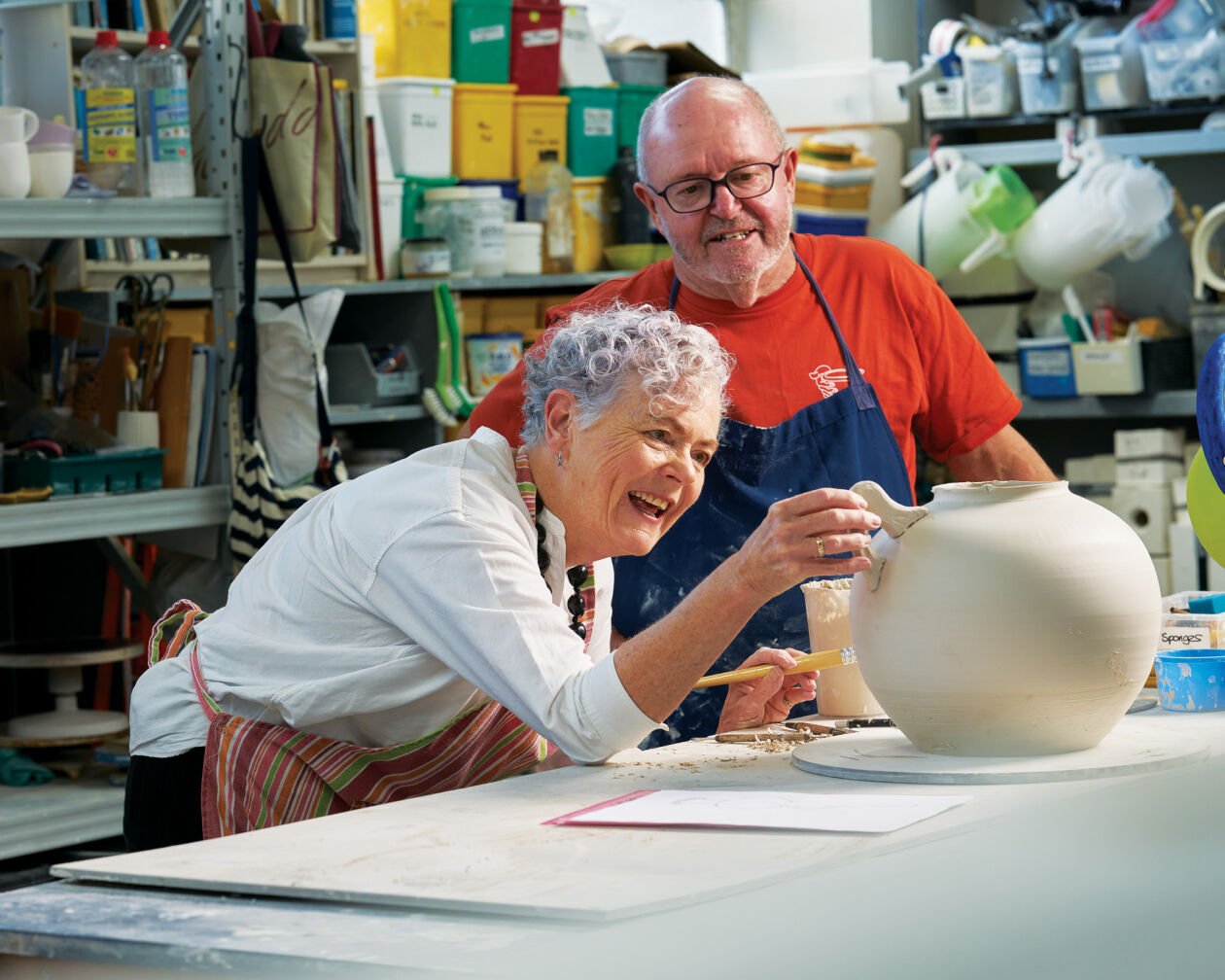
Working at such scale introduces a different set of challenges – structural integrity, weight, and the simple mechanics of forming something oversized. Many of the vessels were built in sections, then assembled and finished as a single form.
"There's a level of skill to it, but it also just comes down to experience – knowing how far you can push the clay before it pushes back," he continues.
In total, Peter and Julie produced around 20 pieces – each one different but connected through form and finish.
"It wasn't formulaic. There was a lot of drawing, testing, assembling. That's what made it enjoyable."
Alongside the Collises' work sits a series of pieces by Auckland-based potter Iza Lozano, whose path into ceramics is a notably different one.
Originally studying social anthropology in Mexico, Iza's interest in pottery came through cultural observation before she was drawn to the technical side of the artform.
"A university field trip to a potters' community in Metepec was the turning point," she recalls. "I became fascinated by the knowledge embedded in the craft – how clay is understood and transformed."
That led to formal study in Mexico City, and eventually to Auckland, where she found a ceramics community that allowed her practice to evolve further.
Iza says her approach draws from archaeology – Mediterranean and Mesoamerican forms, objects that carry a sense of permanence.
"I'm interested in pieces that feel like they've endured. Amphorae, vessels, containers… I'm not replicating them, but referencing their presence," she explains.
For The Pavilion, Iza was asked to adapt her existing forms to fit the space. The result is work that feels both grounded and slightly displaced – familiar in shape but not tied to a single tradition. And like the Collis' work, scale was also part of the challenge for her.
"Larger pieces require patience. You have to think ahead, about structure, weight, how the form holds itself. And then there's the practical side – transporting them, finding kilns large enough to fire them, those sorts of requirements too."
What ties all of this together is not just the material pieces, but the way they have been integrated into the wider space. The resultant artefacts aren't gallery pieces in isolation. Rather, they sit within an interior – objects, focal points and layers created by artisans and expertly positioned by the Pavilion's design team.
"Part of working within interior design is knowing that what you're creating is another layer to consider," concludes Peter. "The entire process is very rewarding indeed."