

Living
Holding Ground
Sharon Hawke's story traces the long aftermath of occupation – through film, journalism and Ngāti Whātua Ōrākei governance — and a legacy spent fighting for Māori stories, memory and self-determination.
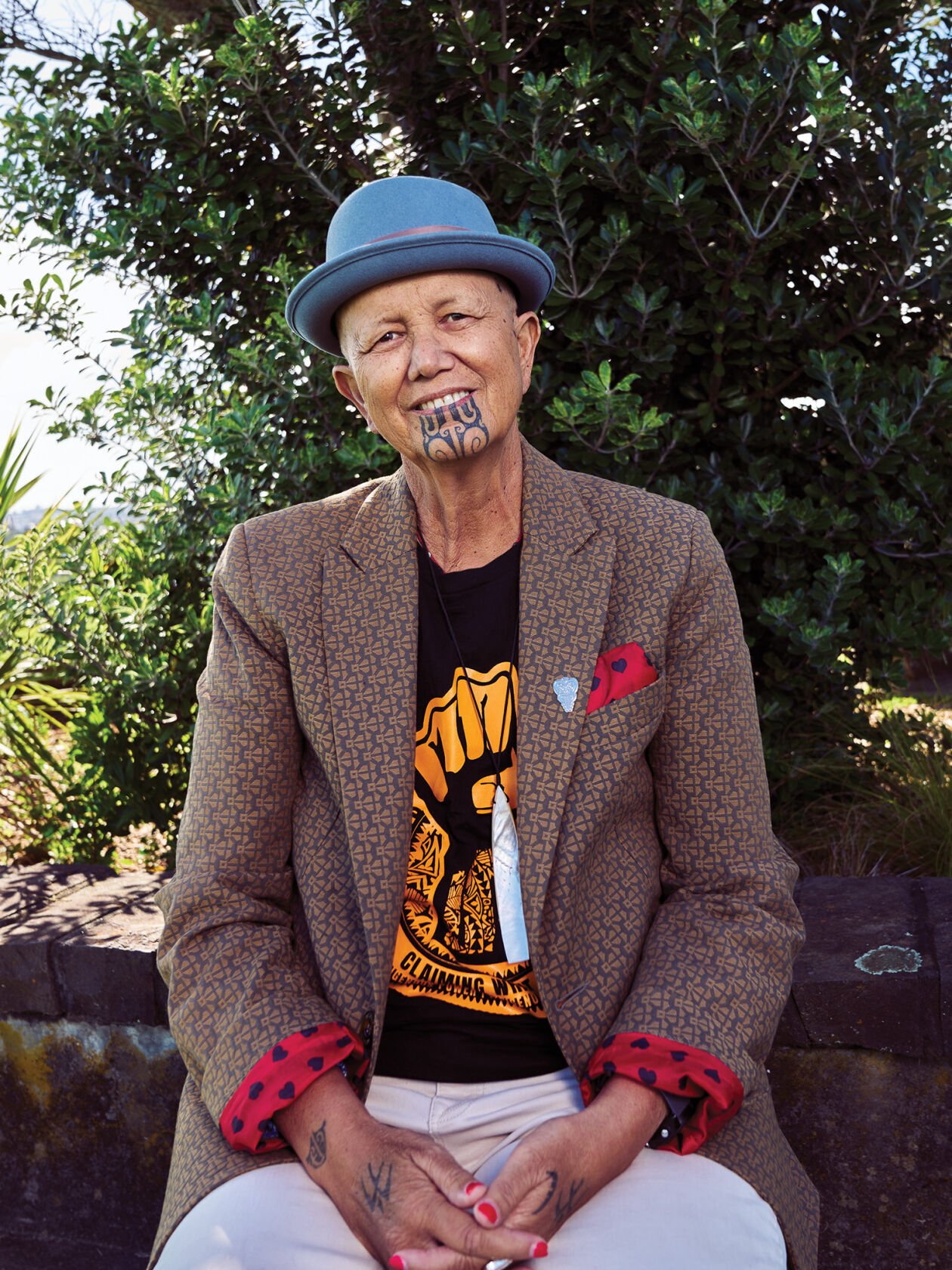
Sharon Hawke grew up in a family already shaped by dislocation. Parts of her childhood were spent between Hawke's Bay, Clevedon and Auckland before the family was drawn back into the politics of Ōrākei and the long struggle over land. That history sat inside family life well before Takaparawhau Bastion Point became a national news story.
Born in 1962, Sharon was 15 when the occupation began and 16 by the time it ended, after the 507 days now closely associated with Takaparawhau Bastion Point.
Led by her father, Joe Hawke, the Ōrākei Māori Action Committee organised and maintained the occupation ahead of the Muldoon Government's plan to use the land for high-end housing. The occupation – protesting Ngāti Whātua Ōrākei's long history of dispossession – began on 5 January 1977, two days before construction of the housing was due to begin.
One of Sharon's sharpest memories is that she was in Dunedin, playing at a national softball tournament, when the occupation started, and watched the news on television. When she returned, everything had changed.
"There were all these tents there, and then they constructed a marae and housing. It was very exciting," she says.
Her mother Rene wanted the children to stay in school and tried, at first, to keep life as settled as possible. But the pull of whānau and place was stronger. "Mum was trying to keep us at school," Sharon says, "but we ended up back there."
She remembers the occupation not only as a political campaign, but as a place with its own routines. There were relatives and supporters coming and going, people living, eating and sleeping in improvised conditions, conversations, and the sense of a community holding itself together in public.
"Life went on," she recalls. "It was normal. We were there almost a year-and-a-half after all."
Those domestic memories sit alongside a much harder political reality. She has looked back in the years since the occupation and realised that, for Ngāti Whātua Ōrākei, it wasn't simply a protest, but a last line of defence.
"They had to make a stand. If they didn't, there'd have been nothing left."
For Sharon, that stand made sense in the context of what had happened to her whānau before – the steady alienation of Ngāti Whātua Ōrākei land, the earlier destruction of papakāinga (home base), and the cumulative effect those losses had on whānau.
For those living through it, the occupation of Takaparawhau Bastion Point was less a beginning than a continuation of a much older argument.
She traces her father's political resolve to an earlier experience of loss.
"As a child, Dad had witnessed the destruction of his people's Papakāinga at Okahu Bay in the early 1950s by the Crown and the distress it caused the older generation. That memory stayed with him."
A successful builder before the 1975 Māori Land March, that pivotal event sharpened Joe Hawke's consciousness, as did his readings of the activities of international liberation movements. He drew from figures such as Martin Luther King Jr., Malcolm X and Mahatma Gandhi, but, she says, "that interest in those kinds of people who make change came from what had happened to our own people here."
The Ōrākei Māori Action Committee movement did not ferment without internal strain. Sharon says not everyone in the wider whānau agreed with Joe Hawke's methods or with taking such a public stand.
"Mum and Dad were devout Christians and many people in the church were against what Dad was doing. Not just people from the wider church community, but first cousins, close friends. They were like, 'What are you doing? Just leave it.'
"But Mum was staunch in her defence of Dad. For her, it became really clear. 'We are fighting the Government because they've stolen Joe's people's land. They have nothing. Don't you get it?' But politics and Christianity didn't mix for some."
As a teenager, she found those divisions difficult to understand. But what remained clear was the lesson she absorbed from her parents.
"Don't lie down and take it," she remembers being taught. "Never give up."
The cost of that struggle was not only political but personal. Public confrontation put pressure on livelihoods and family privacy. Sharon has spoken elsewhere about the strain the movement placed on the household and the sense that everyone was living under close scrutiny. Most tragically, a fire in a tent on 26 September 1977 caused the death of a five-year old girl named Joannee Cooper-Hawke; Sharon's cousin and her parent's niece.
Even so, Sharon doesn't describe anything about the period in terms of regret. Her whānau absorbed the pressures because they believed the alternative was to lose far more.
The occupation was forcibly broken up on 25 May 1978 after 507 days. Police and army personnel moved in en masse, arresting more than 200 occupiers and clearing the site. For New Zealanders, those images became part of the historical record. For Sharon, they marked the destruction of a living place.
"They came in with overwhelming force," she says. "It's something you never forget. We, as a people, will never forget that."
After school, Sharon built a career in film and television, working in camera and production roles including focus puller, camera operator and later director of photography in television drama. She later worked for Māori Television as a producer on Native Affairs, the network's award-winning current affairs programme.
In 1999, Sharon helped produce and edit Bastion Point – The Untold Story, a documentary that revisited the occupation and the longer history of Ngāti Whātua land loss. The project followed the path opened by Merata Mita's Bastion Point: Day 507 but broadened the frame to show the historical depth of the dispute and the cost it imposed on families such as her own.
For Sharon, her involvement in the project was never simply technical. It was also about control of the Takaparawhau Bastion Point narrative.
"Dad become very wary of journalists over the years because the story of Takaparawhau was distorted by the media. I wanted to use the making of the documentary to protect Dad and his story, from his side of things."
Joe and Rene Hawke are both buried on the land they stood firmly in defence of all those years ago. But they lived to see the legacy of the occupation engender great change for Ngāti Whātua Ōrākei. Today, the site of the occupation is Ōrākei Marae and its surrounding streets home to members of the Ngāti Whātua hapū.
Eventually leaving television, Sharon moved into roles with Ngāti Whātua Ōrākei, working within the organisation and later serving as an elected representative involved in the trust structure and its social development arm, following the iwi's treaty-settlement era and the wider post-settlement governance work that followed.
"I'm on two boards. There's the parent board, which runs the whole organisation, and our social development board, which is called Whai Māia," she says. "They run all our social services; the wraparound stuff like rental housing. Our other subsidiary is Whai Rawa, which looks after our wealth in order to give Whai Māia the resource to look after our people."
Sharon speaks with particular pride about housing and social support, and about the effort to bring people home and rebuild the whānau base after generations of displacement.
"The displacement that occurred in the early '50s injured us hugely. The eviction down on the Papakāinga and the burning of our meeting house was truly painful. There was lost language, lost culture; the fabric of our society was destroyed.
"We've lost a lot of elders since. We lost about 30 kaumātua, one after the other, all aggrieved. It's a cultural injury that needs to be apologised for," she says.
However, in other ways, Sharon says Ngāti Whātua is in a position to enjoy a positive future.
"Like everyone, we've been affected by the economy, but we've managed to stay afloat. We've built homes for our people across the road [from Ōrākei Marae] on both sides, and in surrounding streets also. We are rebuilding in every sense," she says.
The continuity between protest and governance has run through Sharon's life. The teenager who lived on occupied land now talks about housing, kaumātua care and institutional responsibility. The form of the response is different, but not its purpose. Through protest, pride and protection, Sharon's whānau is dislocated no more.
"The goals Dad helped establish haven't changed," she says. "It's still the same Kaupapa."
Destruction of the Ngāti Whātua Ōrākei Papakāinga
Having compulsorily acquired the majority of Ngāti Whātua's ancestral Ōrākei land under the Public Works Act, in 1951 the Crown seized the remaining 12.5 acres, leaving the hapū landless except for their local cemetery.
In July 1952, authorities forcibly evicted the remaining inhabitants, with many residents resisting and being physically carried out of their homes. Following the evictions, the village and the marae were demolished and burned to the ground.
The Ngāti Whātua people were relocated to state houses nearby, severing their extended family structures. The displacement of the hapū and the loss of their land left deep emotional and cultural scars, leading to decades of protest.
Since the time of this interview, Sharon Hawke has passed. Sharon passed away in April while on holiday in Samoa, surrounded by those she loved most.
She lived a life of deep purpose. To those who knew her, Sharon was a true wahine toa. She carried strength with grace, led with aroha, and gave of herself to her whānau and community without hesitation. Her presence was steady, her influence far-reaching, and her legacy one that will continue to be felt for generations.
This article stands as a reflection of Sharon in her own words.